

The AI revolution is slowly happening behind closed doors. And many of those at the forefront are using prompt chaining. While the masses are still fumbling with basic chatbots, there’s a select group of digital alchemists who’ve unlocked a power that significantly enhances AI capabilities, allowing it to handle more complex tasks with greater precision and control.
If you’re ready to learn how to transmute ordinary AI interactions into pure digital gold, strap in. You’re about to join the inner circle.
Prompt Chaining: A New Era in AIWhat is Prompt Chaining?Forget what you thought you knew about AI interaction. Prompt chaining is more than just another method—it’s a shift that differentiates basic users from advanced practitioners. At its heart, prompt chaining breaks down complex tasks into a series of linked prompts, where each output serves as the input for the next step.
How Does It Work?Prompt chaining involves using the output from one AI prompt as input for another, forming a sequence or “chain” of prompts. This technique allows users to divide complex tasks into smaller, manageable steps, with each step addressed by a distinct prompt. By chaining these prompts together, users can achieve more sophisticated and precise outcomes than a single prompt would allow.
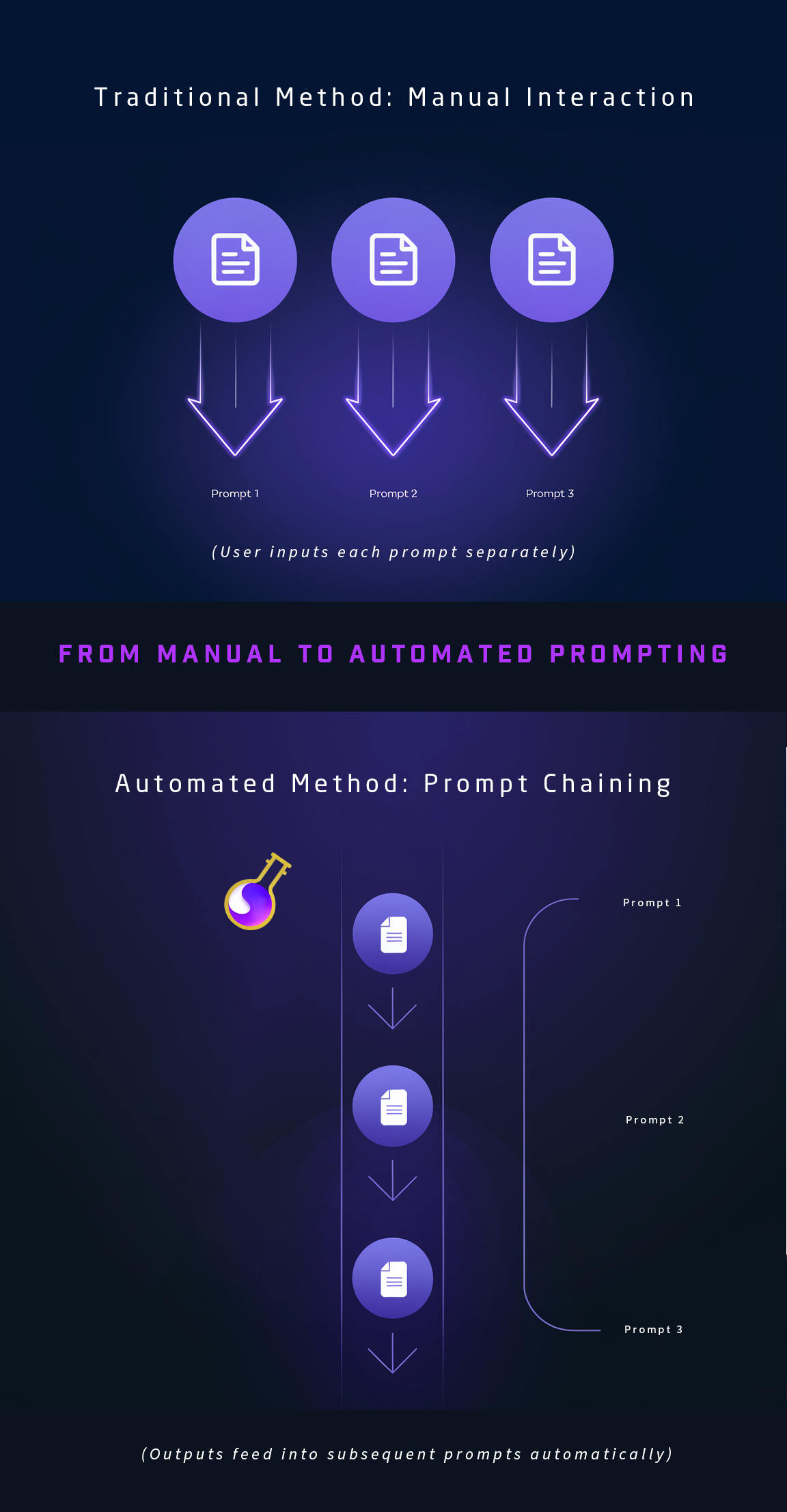 The key to prompt chaining is leveraging the strengths of AI models while mitigating their limitations. One day we may not need prompt chaining, as models progress, or we may use more advanced methods like autonomous agents. For now, prompt chaining remains one of the most effective ways to achieve sophisticated results.
By structuring a sequence of prompts, users can guide AI through complex reasoning or creative processes, similar to how a person might approach a multi-step problem or workflow. For instance, content creation involves multiple specialists—writers, researchers, editors, SEO experts—each with their own series of steps and iterations. When implemented skillfully, prompt chaining can streamline and enhance much of this process, potentially revolutionizing how we approach complex, multi-faceted tasks and workflows in various fields.
For Those New to AI:
🥪Imagine you’re teaching a child how to make a sandwich. Instead of giving all the instructions at once, you break it down: “First, select the bread. Next, decide on the spreads. Now, let’s add the main ingredients.” That’s prompt chaining—breaking complex tasks into simpler, actionable steps. But its more than this: The result from prompt 1 will be feed into prompt 2, prompt 2 result will be feed into prompt 3, and so on. So you can think of it as each prompt is a step in a workflow.Why Use Prompt Chaining?I’ve found prompt chaining to be the secret ingredient in my AI Goldmines. It’s not just a technique; it’s the backbone of transforming raw data into digital gold. I often end up creating such complex (single) prompts that the AI struggles, even when using the most advanced LLM. In these cases, there is just too much information, too many instructions, that the AI model flat out won’t follow your detailed instructions. Not only that, sometimes you need to pull in data from somewhere else (like implementing research for instance, or pull in data from an API, to integrate data from another tool or source) — in this case prompt chaining comes to save the day.Here’s why I’m passionate about prompt chaining:
Key Features I Leverage:
By mastering these principles, I’ve been able to create AI Goldmines that consistently produce high-grade digital assets across various business models. Whether it’s SEO-optimized content, captivating books, or tailored marketing sequences, prompt chaining is the alchemical process that turns data into true digital gold.
Ready to stop settling for digital pebbles and start mining for real value? Let’s explore how prompt chaining can revolutionize your approach to AI and business.
Now that you understand the basics of prompt chaining, try breaking down one of your own complex tasks into a series of prompts. Here’s a simple example of a three-prompt chain for writing a blog post:
Prompt 1: "Generate an outline for a blog post about the benefits of meditation for stress reduction."

Prompt 2: "Based on this outline: {result from prompt 1}, write an introduction paragraph that hooks the reader and briefly introduces the main points."

Prompt 3: "Using this outline and introduction: {result from prompt 2}, expand on the first main point with specific examples and scientific evidence."

...and so on
In the next section, we’ll explore why prompt chaining is so powerful and some advanced techniques for optimizing your prompt chains.
Why Prompt Chaining is a Critical Tool in AIPrompt chaining is not just a clever trick—it’s becoming a vital tool in AI development. Here’s why it’s gaining so much traction:
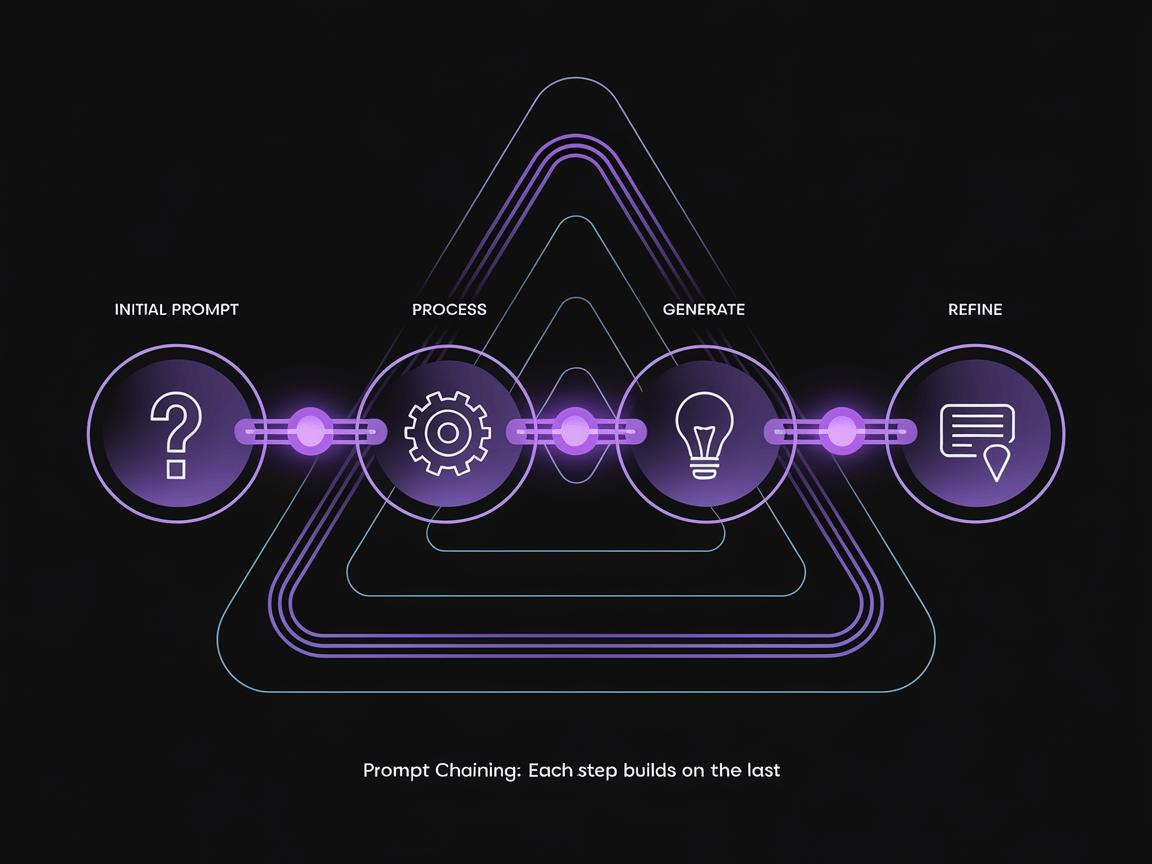 – Complexity Management: As AI models become more advanced, the tasks we ask of them also grow more complex. Prompt chaining allows us to break down these complex tasks into simpler, more manageable parts. Think of it like turning a complex knot into individual loops you can easily untangle.
Breaking Down the Mechanics of Prompt ChainingLet’s delve into the mechanics behind prompt chaining:
This isn’t just theory—it’s practical knowledge gained from real-world applications. Mastering these steps will empower you to create effective prompt chains that can handle complex tasks with precision.
The Alchemist’s Lexicon: Key Terms You Need to KnowBefore we dive deeper into prompt chaining, let’s familiarize ourselves with some key terms:
Understanding these terms will help you navigate the process of prompt chaining with ease.
Implementing Prompt Chains: From Theory to PracticeReady to put prompt chaining into action? Here’s how you can implement it:
For the No Code Enthusiasts—AirtableAirtable has been my go-to tool for years. Its not just for quick prompt chain prototyping, its always been amazing at creating custom workflows and managing complex business processes.In the past 1-2 years or so, I’ve discovered it’s also the perfect prompt chaining tool, especially for those who aren’t comfortable with code (or having LLMs create code for them). Its visual and intuitive interface makes it ideal for structuring and managing prompt chains. And it makes it really easy to test and iterate on each prompt in your workflow.
Real World Example for my ongoing project: ContentCreation.aiThis screenshot showcases my highly sophisticated prompt chain for creating amazing competitively positioned SEO articles—a system designed I’ve spend about a full year on, to produce some truly epic content. This workflow is the culmination of my 15 years of SEO expertise, meticulously integrated into each prompt and the overall process:
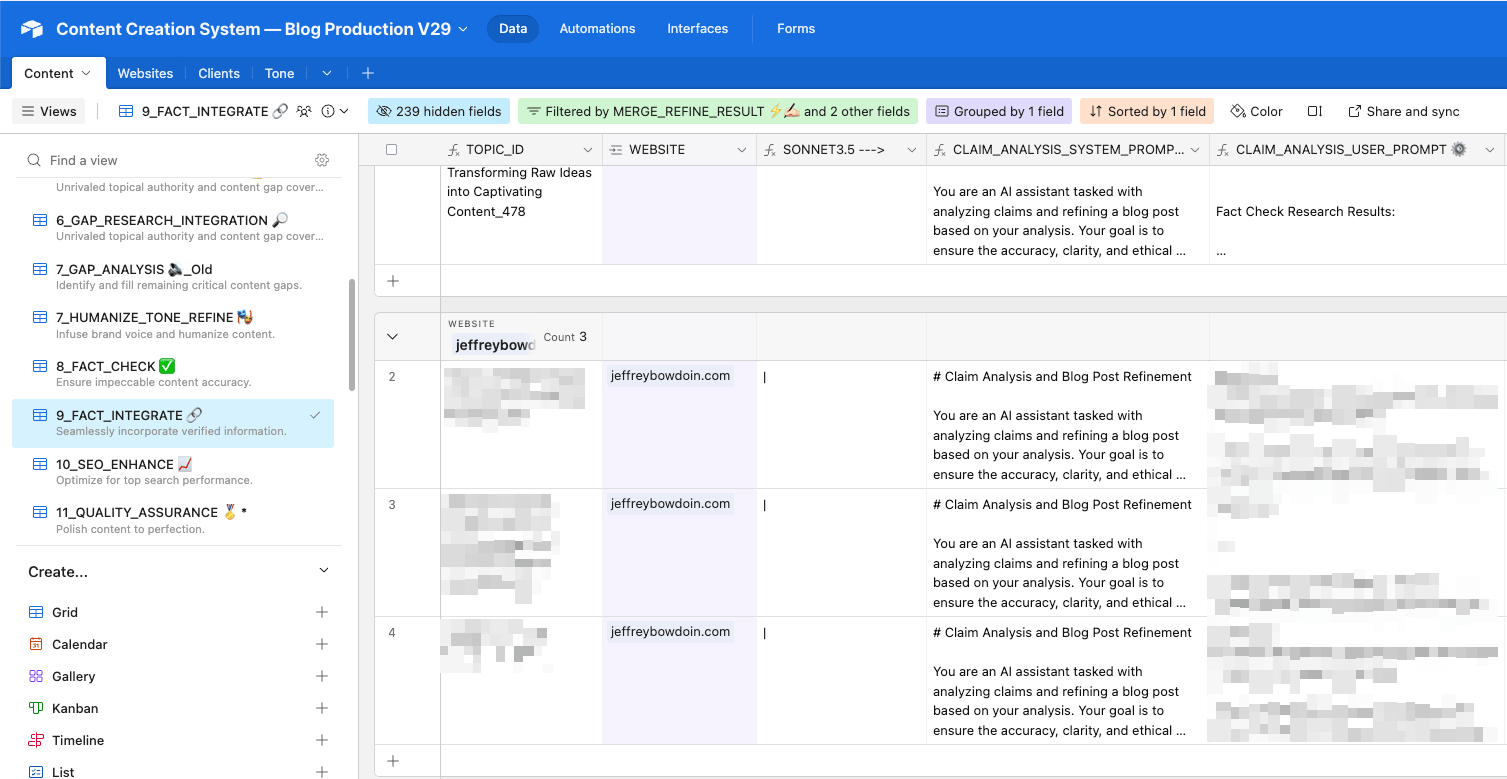 While I still edit, contribute significant original writing, and refine the content (maintaining a hybrid human-AI approach), the time savings this prompt chain workflow provides are truly astronomical. It’s by far the most advanced system I’ve ever used—unsurprisingly, as I created it myself to meet the exacting standards required in today’s competitive SEO landscape.
The efficiency and quality of output from this system are so impressive that I’m currently in the process of developing it into a product—either as a SaaS solution or as the actual Airtable workflow with an accompanying course (I’m still deciding). My goal is to make this powerful tool accessible to others in the industry, allowing them to benefit from the same level of sophistication and time savings in their SEO content creation process. I feel it’s quite impressive, and as a perfectionist with content and SEO, I’ve developed the system to include over 30 prompts in a chain, which I’m still refining.
This prompt chain is a real-world example that represents not just a systematized workflow, but a distillation of years of experience and best practices in SEO, all orchestrated to work seamlessly with AI capabilities. It’s a testament to how far you can take prompt chaining while still maintaining the crucial human touch that ensures high-quality content.
How to Use Airtable for Prompt Chaining:
Example formulas:
Concatenate
CONCATENATE(“Based on the previous output: “, {Previous Step Output}, “, please provide “, {Current Step Instruction})
My go-top simple method:
“Please consider the following: n”&{Field Name}…
This formula combines the output from a previous step with new instructions, creating a dynamic prompt for the next step in your chain.
While Airtable’s visual nature makes it intuitive, there is a learning curve, especially when it comes to mastering formulas and automations. However, the effort to learn is well worth it, as it enables you to create sophisticated prompt chains without writing a single line of traditional code.
By leveraging Airtable’s powerful features, you can create flexible, visual, and easily modifiable prompt chains that can handle complex workflows and iterative AI interactions.
For the Code Enthusiasts—PythonHere’s an example of what a basic prompt chain implementation might look like in Python:
import openai
Set your OpenAI API key (replace with your actual key)
openai.api_key = “your-api-key-here”
Function to handle a sequence of prompts (prompt chain) for solving a complex task
def prompt_chain(initial_input):
# Initialize a dictionary to hold context, starting with the initial input
context = {“input”: initial_input}
# Function to execute the prompt using OpenAI API
def execute_prompt(prompt_template, context):
# Fill the prompt with the context data (replacing placeholders)
filled_prompt = prompt_template.format(**context)
# Use OpenAI’s API to generate a response
response = openai.Completion.create(
model=”text-davinci-003″, # Or use a different model like GPT-4
prompt=filled_prompt,
max_tokens=100, # Adjust this based on your needs
temperature=0.7 # Adjust temperature for creativity
)
# Return the AI’s response text, stripped of leading/trailing whitespace
return response[‘choices’][0][‘text’].strip()
# Step 1: Perform an initial analysis of the input
prompt1 = “Analyze the following input: {input}”
context[“analysis”] = execute_prompt(prompt1, context)
# Step 2: Generate ideas based on the analysis
prompt2 = “Based on this analysis: {analysis}, generate three innovative ideas”
context[“ideas”] = execute_prompt(prompt2, context)
# Step 3: Evaluate the generated ideas
prompt3 = “Evaluate these ideas: {ideas}. Provide pros, cons, and potential impact.”
context[“evaluation”] = execute_prompt(prompt3, context)
# Step 4: Final recommendation
prompt4 = “Based on this evaluation: {evaluation}, recommend the best course of action.”
final_result = execute_prompt(prompt4, context)
# Return the final result from the entire prompt chain
return final_result
Example usage
complex_task = “Develop a groundbreaking AI-driven product for the finance sector”
result = prompt_chain(complex_task)
print(result)
This isn’t just a code snippet—it’s a blueprint for digital alchemy. Customize it, expand it, and make it your own. The possibilities are only limited by your imagination and audacity.
Advanced Techniques: Where the Real Magic HappensOnce you’ve got the basics down, it’s time to step into the advanced territory. This is where you separate yourself from the pack:
Chain-of-Thought (CoT) Prompting:Encourage your AI to show its work. It’s like getting a peek inside Einstein’s brain while he’s solving relativity.
Prompt: "Analyze this financial data: [data].
Step 1: Identify key metrics.
Step 2: Calculate growth rates.
Step 3: Compare to industry benchmarks.
Explain your thought process for each step, and don't hold back on the insights."
Recursive Refinement:Use the output of one chain as input for another iteration. It’s like putting your ideas through a particle accelerator, refining them to perfection.
import openai
Set your OpenAI API key (replace with your actual key)
openai.api_key = “your-api-key-here”
Recursive function to iteratively refine the result of a prompt chain
def recursive_refine(initial_input, max_iterations=3):
# Start with the initial input as the result
result = initial_input
# Loop through a maximum number of iterations (default is 3)
for i in range(max_iterations):
# Call the prompt chain again, using the current result as input for the next iteration
result = prompt_chain(result)
# Perform a quality check on the result (define quality_check elsewhere)
# If the result meets the desired quality, exit the loop early
if quality_check(result): # quality_check should be a function that you define
break
# Return the final refined result after iterative improvements
return result
Dynamic Chain Construction:Build your chain on the fly based on intermediate results. It’s like having an AI that can improvise like a jazz master.
Function for dynamically constructing a prompt chain based on intermediate results
def dynamic_chain(input):
# Initialize the context with the initial input
context = {“input”: input}
# Determine the steps required based on the input
steps = determine_steps(input) # You’ll need to define this function
# Loop through each determined step and execute the corresponding prompt
for step in steps:
# Retrieve the appropriate prompt for the current step
prompt = get_prompt_for_step(step) # You’ll need to define this function
try:
# Execute the prompt and store the result in the context
result = execute_prompt(prompt, context) # You’ll need to define this function
context[step] = result # Store the result in the context dictionary
except Exception as e:
print(f”Error executing step {step}: {e}”)
return None
# Return the final result from the context, assuming it’s stored in “final_result”
return context.get(“final_result”, None)
Multimodal Chaining:Integrate different types of data—text, images, audio—into your prompt chains. It’s like giving your AI synesthesia, allowing it to see sounds and hear colors.
Function for chaining multimodal data (text + images) to generate an output
def multimodal_chain(text_input, image_input):
# Analyze the image using a separate image analysis model
# image_analysis_model should be defined elsewhere; it processes image_input and returns analysis
image_analysis = image_analysis_model(image_input)
# Create a text-based prompt that combines the image analysis and text input
text_prompt = f”Given this image analysis: {image_analysis}, and this text: {text_input}, generate a comprehensive report that’ll blow minds.”
# Use a text generation model to generate the final report based on the combined inputs
# text_generation_model should be the AI model handling text generation
return text_generation_model(text_prompt)
Meta-Learning Prompts:Design prompts that teach the AI how to approach entire categories of tasks. It’s like giving your AI a crash course in problem-solving before it even starts.
Prompt: "You're now a leading expert in disruptive innovation. Your approach involves identifying market inefficiencies, leveraging cutting-edge tech, and thinking ten steps ahead of the competition. Apply this mindset to analyze the following business proposal: [proposal]"
Context Management:Think of this as giving your AI a photographic memory. Carefully curate the context provided to each prompt in the chain. You might need to summarize previous outputs or cherry-pick the most relevant info to keep your AI laser-focused.
Memory Mechanisms:Implement a digital hippocampus for your AI. Create mechanisms to store and recall crucial information throughout the chain. You could design a “memory” prompt that accumulates key details, ensuring your AI doesn’t forget that brilliant insight from step 2 when it reaches step 17.
Hybrid Human-AI Chains:Combine the raw power of AI with human intuition. Design chains that incorporate human input at critical junctures. It’s like creating a digital centaur – half human creativity, half AI processing power.
These aren’t just fancy tricks—they’re the tools that’ll let you craft AI systems capable of handling tasks so complex and nuanced, they’ll seem like magic to the uninitiated.
Optimization and Context Management: Fine-Tuning Your Digital AlchemyTo squeeze every ounce of power out of your prompt chains, you need to master the art of optimization and context management. Here’s how to take your chains from good to mind-blowingly efficient:
Real-World Applications: Where the Rubber Meets the Road Enough theory—let’s talk about where this really shines. Here are some perfect applications of prompt chaining that’ll make you rethink what’s possible in business and in creating digital gold (Value creation on steroids)
These aren’t just examples—they’re glimpses into a future where AI doesn’t just assist, it transforms entire industries. With prompt chaining (assuming it is relatively advanced and works well), you’re not just solving problems; you truly are redefining what’s possible.
Why Prompt Chaining Shows Promise for Complex TasksPrompt chaining shows promise in handling complex tasks more effectively than single prompts, though more research is needed to quantify its advantages across different scenarios. Here’s why prompt chaining is looking like the heavy artillery you need:
Aspect
Prompt Chaining
Single Prompts
Task Complexity
Shows potential for handling multi-step, brain-bending tasks effectively
May struggle with more complex queries
Context Retention
Builds and maintains context throughout the process
May have limitations in retaining context for complex tasks
Error Handling
Offers opportunities to catch and correct errors at multiple stages
Errors may be more difficult to identify and correct
Flexibility
Adapts to different tasks through modular design
May be less flexible for varied task types
Control
Offers more granular control over the AI’s process
Control may be more limited
Output Quality
Potential for more refined and accurate results
Quality may vary depending on task complexity
Resource Usage
May require more computational resources
Generally more lightweight
Implementation Complexity
Requires more upfront planning and design
Typically easier to implement
Scalability
Shows promise for scaling to very complex tasks
May face limitations with increasing task complexity
Explainability
Can provide insights into the AI’s decision-making process
Often less transparent in its reasoning
In the real world, complexity isn’t the exception—it’s the rule. Prompt chaining isn’t just a promising option; it’s potentially your secret weapon for navigating the chaotic, multifaceted challenges that define cutting-edge AI applications. However, it’s important to note that more research is needed to fully quantify and understand its advantages across different scenarios.
Best Practices: The Alchemist’s HandbookWant to elevate your prompt chaining game from amateur hour to grandmaster? Burn these best practices into your brain:
Stick to these practices, and you’ll create prompt chains that aren’t just powerful—they’re adaptable, maintainable, and ready to take on tasks that would make lesser AIs cry for their silicon mothers.
The Future of Prompt ChainingAs we push the boundaries of AI, prompt chaining is set to evolve in exciting ways. Here’s a glimpse into the crystal ball:
The future of prompt chaining isn’t just bright—it’s transformational. We’re on the cusp of AI capabilities that will redefine what’s possible.
Overcoming Challenges: When Things Go WrongEven with powerful tools like prompt chaining, challenges can arise. Here’s how to address common issues:
By anticipating and addressing these challenges, you’ll build prompt chains that are resilient, adaptable, and capable of handling complex tasks.
Wrapping Up: Be the Innovator In Your FieldPrompt chaining is not just another AI tool—it’s your key to thriving in today’s dynamic business landscape. It elevates AI from basic chatbot interactions to systems capable of tackling intricate, real-world challenges. Whether you’re navigating complex business problems, exploring creative innovation, or managing vast datasets, prompt chaining will be your competitive advantage.
I believe every company should consider introducing a new role: Prompt Chain Architect. This role goes beyond prompt engineering, requiring a strategic mindset to break down tasks, guide AI through multi-step processes, and anticipate potential roadblocks. It’s about thinking several steps ahead and crafting chains that do more than solve problems—they optimize your AI’s performance and deliver exceptional results.
As you continue your journey in AI and prompt engineering, keep pushing the boundaries, experimenting, and innovating. The AI landscape is evolving quickly, and mastering prompt chaining will be crucial to staying ahead.
So, go ahead—turn simple AI interactions into something extraordinary. Build chains that not only stand out but also solve problems in ways your competitors haven’t even imagined. In this ever-evolving AI world, you’re not just observing the future—you’re creating it.
Welcome to the inner circle, Alchemist. Now go work your magic!