

I’ve definitely been there—spending hours tweaking AI prompts only to see wildly inconsistent results. What if you could teach the AI to design better prompts for you? What if you could create better prompts, in significantly less time? That’s where metaprompting shines. It transforms AI workflows from frustrating guesswork into scalable systems, all by creating a sort of “blueprint” that instructs the AI on how to create effective prompts.
In fact, mastering meta prompts is arguably the de facto skill any prompt engineer can develop—because it lets you dramatically increase efficiency and improve quality without reinventing the wheel each time.
This guide unpacks how metaprompting works and why it’s an essential skill for anyone implementing AI solutions, whether you’re a solo enthusiast or working in an enterprise setting. Let’s dive in.
Metaprompting Demystified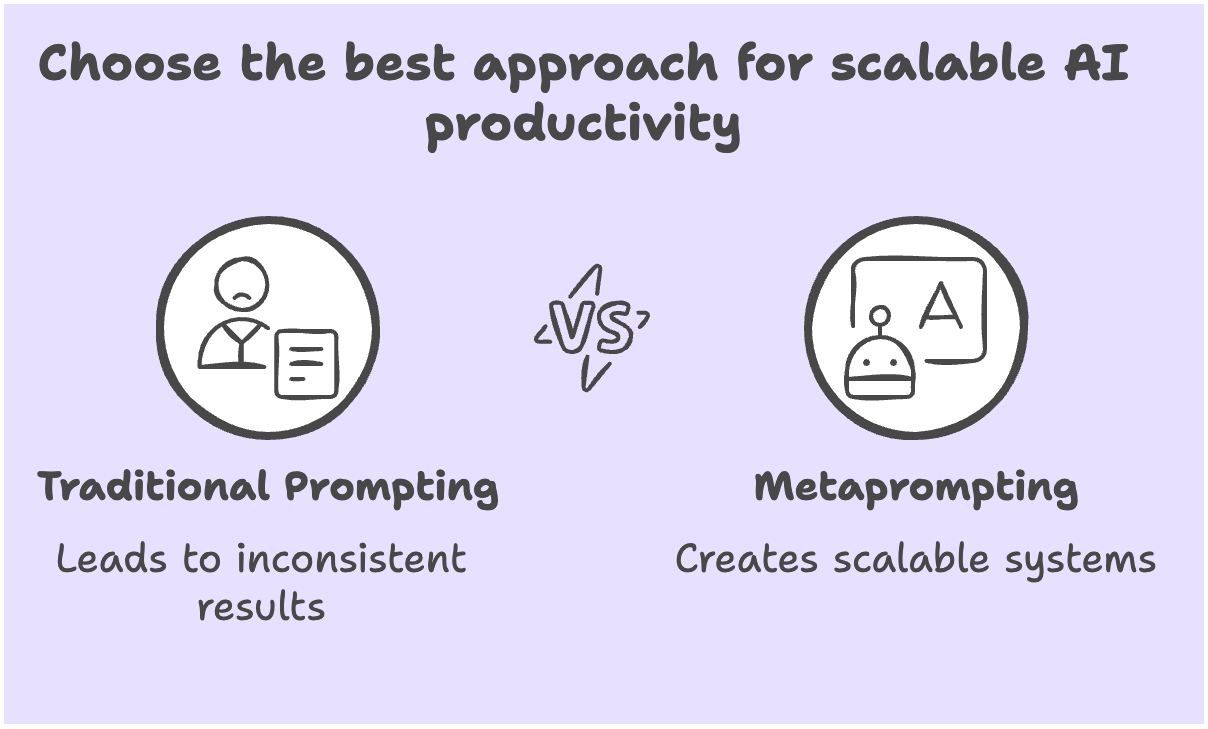 You are sitting there in front of ChatGPT or your favorite LLM. You try to think of instructions (also called “prompts”) for every different task you want it to do—such as writing an email, summarizing an article, or brainstorming new product ideas. Normally, you’d create each of those prompts yourself, one by one. With Metaprompts, it’s a little different.
Enter metaprompting: you give the AI a single, higher-level set of instructions—like a “blueprint”—that teaches the AI how to write prompts on its own.
It’s kind of like building an automated prompt engineer right inside the AI. Instead of writing detailed instructions for each task, you specify rules, structure, and examples in a single meta-instruction. The AI then follows this blueprint to create prompts tailored to your objectives.
Think of It Like Hiring an “AI Prompt Engineer”
By doing this, the AI essentially learns your “prompt-writing style” or you simply tell the AI to apply “prompt engineering best practices” and from this process, you can automatically end up with much better, more consistent prompts for each new situation—so you spend much less time creating and refining your prompts, all while getting significantly better outputs.
Metaprompts Could Include:
Essentially, metaprompting is a higher-level approach where you produce a “master prompt” telling the AI how to generate or refine other prompts. While there isn’t a universally accepted definition of a meta prompt—since the term is still evolving—its concept remains quite practical.
It’s as Simple or Complex as You WantMetaprompts can range from beautifully simple to intriguingly complex. Just to show you an example of what I’m talking about, here are three examples illustrating how you can start small and scale up to more advanced uses.
1. The Basic Approach> Create a prompt that will create an SEO-optimized blog post on [Topic].
This metaprompt is straightforward: the AI will generate a single prompt focused on producing SEO-friendly content.
2. A More Detailed Example> Create a comprehensive prompt that will create an SEO-optimized blog post on [Topic]. Ensure the prompt uses chain-of-thought reasoning to mimic a high-end agency workflow, which includes a user intent analysis to guide the content direction.
Here, you’re guiding the AI to include extra steps—like user intent analysis—so the final blog post aligns with a more sophisticated marketing strategy.
3. Fully Loaded Agency-Style Metaprompt> Generate a prompt that will create an SEO optimized and high-conversion oriented blog post on [Topic]. This prompt should include chain-of-thought reasoning, an in-depth user persona profile, an outline of competitor insights, and a strategy for on-page optimization (headings, meta tags, etc.). Additionally, instruct the AI to draft a content calendar for the next three articles based on the same topic, ensuring each piece targets a distinct but related keyword (with recommended internal link anchor text).
In this version, you’re layering multiple advanced elements:
This approach simulates some of the thoroughness of an agency workflow, all from one self-contained metaprompt.
This would create a decently detailed and high quality prompt in very little time. I’ll admit though that these are very simple prompts. On the more sophisticated end, I typically work with very long, detailed metaprompts that orchestrate entire workflows, dynamically adjusting the AI’s responses based on outputs and contextual requirements.
The most simplistic examples likely involve something like: “Create a prompt on…” followed by your needs or examples. From there, the AI can generate a more refined and detailed prompt for you. This approach not only streamlines your prompt creation process but also enhances the richness of the interactions you can have with the AI.
From my experience implementing these systems, the real power lies not in their complexity, but in choosing the right level of sophistication for your specific needs. Sometimes the simplest approach delivers the most impactful results. For me, my most common use of metaprompts is simply to save time in creating prompts.
Core Definitions — Attempting to Define Meta PromptsMeta prompts extend far beyond simply having AI create prompts or providing instructions about prompt creation.
The concept of metaprompting can be a bit slippery, as different AI practitioners and researchers define it in varying ways. They encompass a diverse range of methods and use cases, making it more accurate to think of “meta prompting” as an umbrella term that covers various advanced prompting techniques.
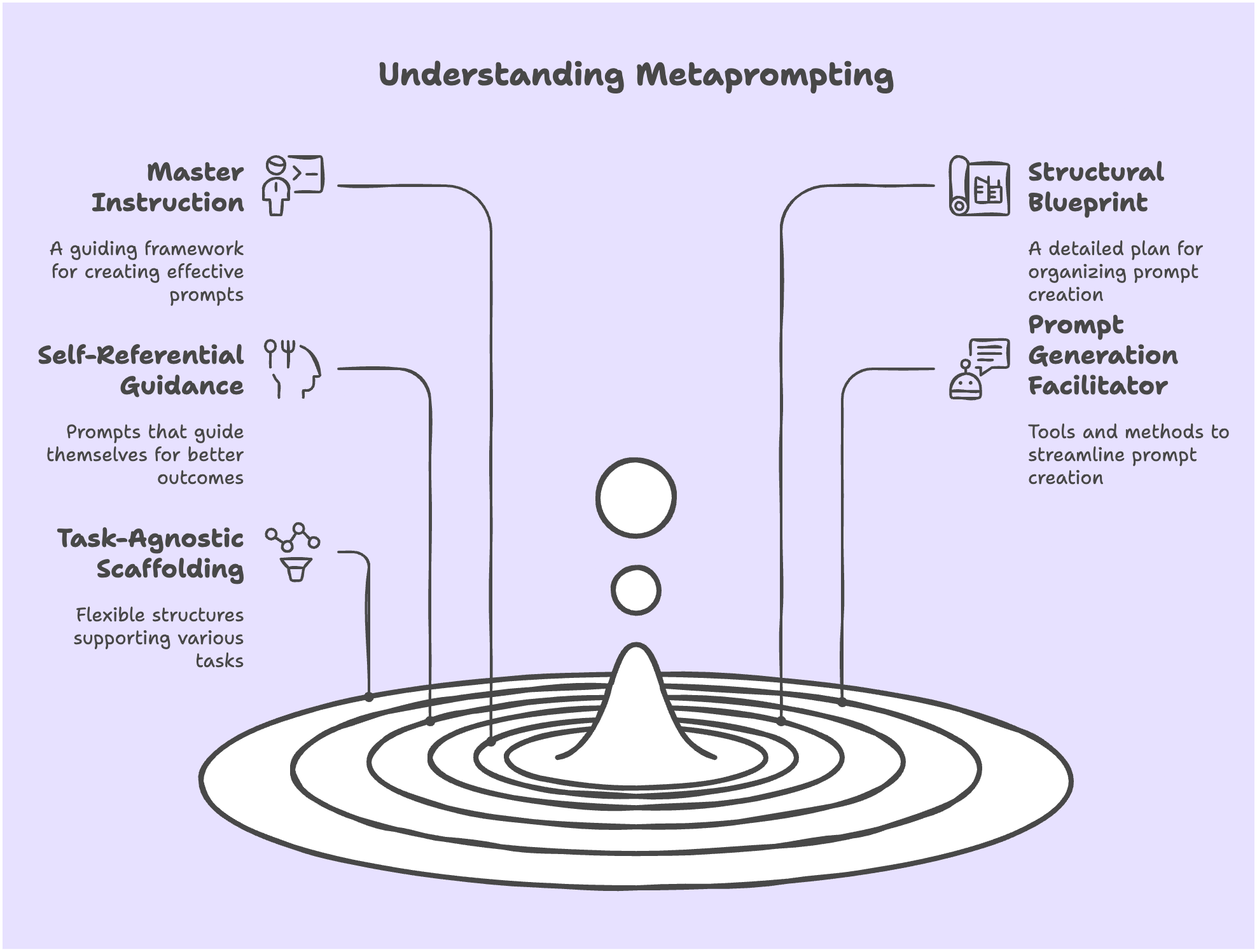 Rather than declaring one definition as “correct,” it’s more valuable to acknowledge this natural diversity of definitions—which is quite common in a rapidly evolving field like Prompt Engineering. Here are some common definitions of Meta Prompts:
1. Master InstructionDefinitionA meta prompt is a “prompt for prompts”—a high-level instruction that tells the AI how to generate, refine, or interpret other prompts. You provide the overarching rules, and the AI uses that blueprint to craft task-specific prompts.
Plain-Language Explanation
It’s the big-picture guide. Instead of asking for a specific result, you tell the AI how to ask for that result.
Example
2. Structural BlueprintDefinitionA meta prompt is an abstract, structural prompt that emphasizes the syntax and form over detailed content. It’s like a scaffold or template that guides subsequent prompts for consistency and adaptability.
Plain-Language Explanation
It’s a skeleton or template: you define how to structure any future instructions or requests, focusing on the format more than the details.
Example
3. Self-Referential GuidanceDefinitionMeta prompting as instructing the AI to “think about how to prompt itself.” The AI generates or modifies its own prompt to achieve a desired outcome, creating a recursive or self-improving loop.
Plain-Language Explanation
You tell the AI to look at its own prompts or responses and then fix or improve them. It’s like giving the AI a mirror so it can see if it’s missing something.
Example
4. Prompt Generation FacilitatorDefinitionA meta prompt acts as a guide or template for creating effective questions. It helps either users or the AI itself craft prompts that are more detailed, context-aware, and aligned with specific goals.
Plain-Language Explanation
It’s like a helpful checklist: you provide guidelines that ensure every prompt asks for exactly the right info.
Example
5. Task-Agnostic ScaffoldingDefinitionA meta prompt functions as a task-agnostic scaffolding technique, enabling the AI to break down complex instructions into simpler sub-tasks. By first creating an overarching prompt, it can be adapted across multiple domains or problems.
Plain-Language Explanation
You set up a universal game plan that can be reused for any type of project or question, so the AI knows how to break down big goals into smaller steps.
Example
Additional Definitions & Techniques6. Iterative RefinementDefinitionMeta prompting can guide the AI to refine or elaborate on responses step by step. Instead of getting a single answer, the AI systematically revisits and improves its output.
Plain-Language Explanation
You tell the AI to go through multiple drafts—generate a rough version, then refine it, then finalize it.
Example
For a more in-depth approach to repeated prompt improvement, refer to this Iterative Prompt Guide from Google.
7. Context Reframing or Perspective ShiftingDefinitionA meta prompt instructs the AI to restate or reframe existing prompts in different contexts or viewpoints.
Plain-Language Explanation
Get the AI to take the same problem but look at it from another angle or adapt it to a new audience.
Example
8. Error Analysis and Self-CorrectionDefinitionA meta prompt can direct the AI to spot mistakes or inconsistencies in its output (such as factual errors, logical flaws, or unclear wording) and correct them.
Plain-Language Explanation
It’s like asking the AI to proofread and fix its own homework before it hands it in.
Example
9. Role-Based PromptingDefinitionA meta prompt assigns specific perspectives or “roles” to the AI (e.g., “act as a teacher,” “act as a critic”), directing how it should generate further prompts or outputs.
Plain-Language Explanation
You’re telling the AI to ‘wear a different hat.’ By shifting roles, the AI can generate varied prompts or answers that reflect that perspective.
Example
Putting It All Together- Meta prompts can be mixed and matched. For instance, you might create a Master Instruction that includes a Structural Blueprint and also instructs the AI to Iteratively Refine its prompts.
Quick Reference Table
Definition
Key Point
Example in One Sentence
Master Instruction
High-level prompt for generating other prompts.
“Always include a clear call to action in every email prompt you create.”
Structural Blueprint
Emphasizes format/syntax over content.
“Each prompt must have (1) Objective, (2) Steps, (3) Checklist.”
Self-Referential Guidance
AI reviews or modifies its own prompts.
“Look at your last response, find any jargon, and rewrite it for a layperson.”
Prompt Generation Facilitator
A guide to craft detailed, goal-aligned prompts.
“Include target audience and constraints whenever asking for design ideas.”
Task-Agnostic Scaffolding
Universal framework for breaking down complex tasks.
“Break any problem into sub-tasks, generate prompts for each, then unify them.”
Iterative Refinement
Step-by-step improvement process.
“Outline first, add detailed stats, then finalize the text.”
Context Reframing/Perspective
Adapt or restate content for different contexts.
“Explain the concept to a child, then to an expert.”
Error Analysis and Self-Correction
AI checks and corrects its own work.
“Fix any logic errors in the code you just wrote.”
Role-Based Prompting
AI takes on different personas or viewpoints.
“Act as a supportive mentor, then as a strict critic, then synthesize both.”
Why This Changes EverythingMany who are new to large language models discover that tiny tweaks can drastically change the AI’s output. It’s tedious to test every variation by hand, especially under tight deadlines. Metaprompting addresses this challenge by embedding your overarching instructions into the AI itself.
For more insights on how minimal input can lead to surprising performance, see Language Models Are Few-Shot Learners.
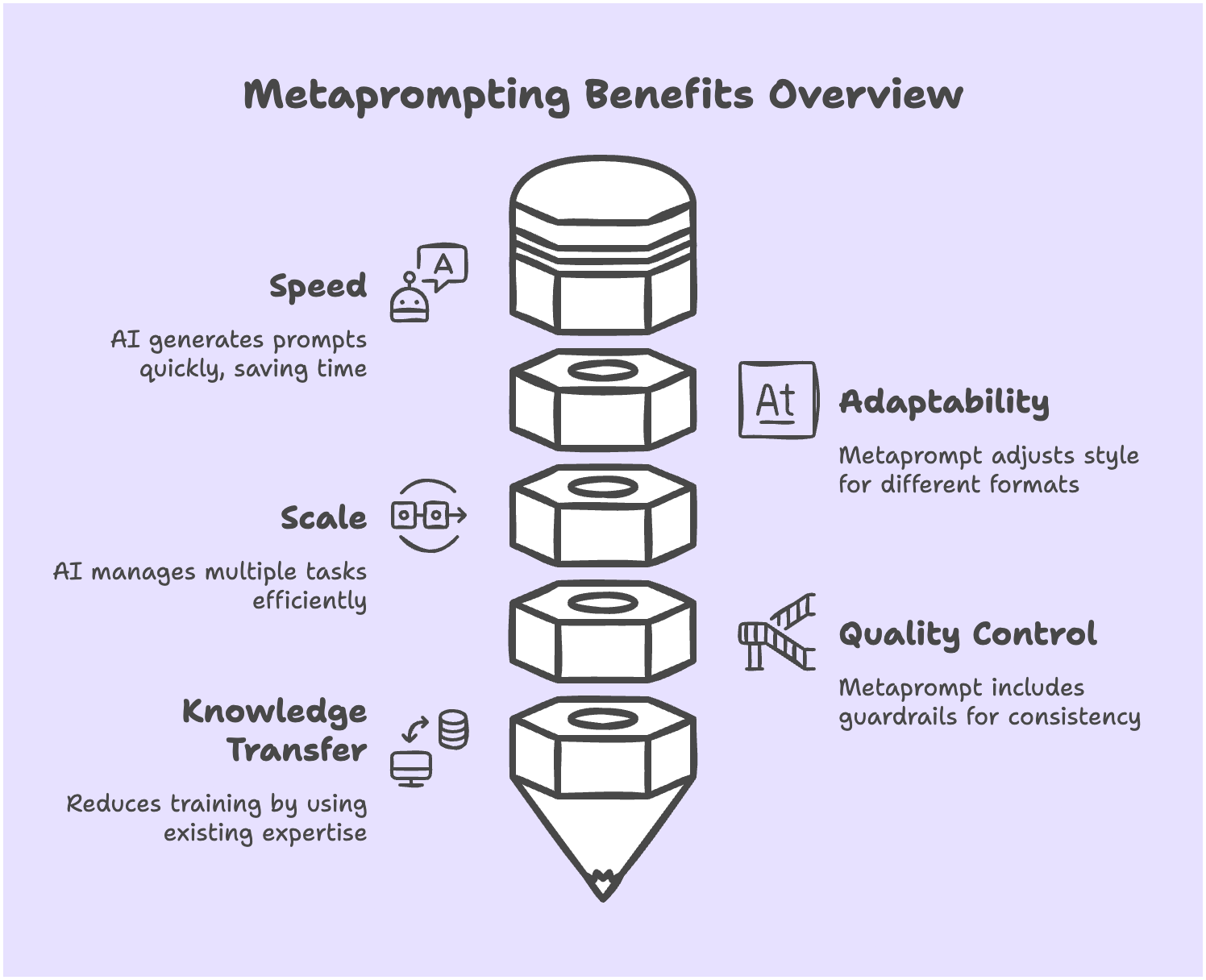 Here are five persistent pain points it solves:
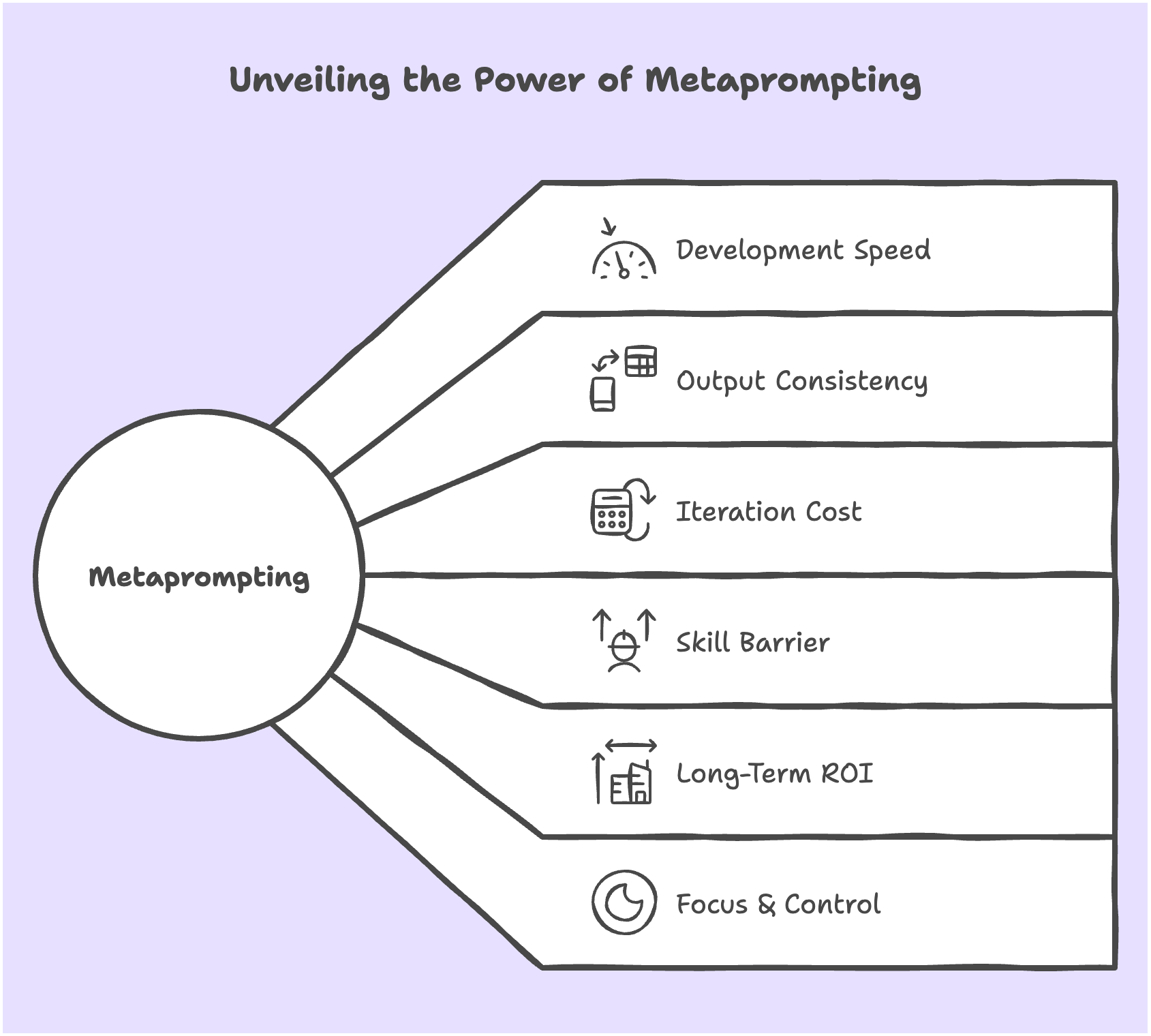
Traditional vs. MetapromptingTo illustrate why metaprompting is so powerful, take a look at how it stacks up against the old-school way of handcrafting prompts:
Factor
Traditional Prompting
Metaprompting
Development Speed
Hours per prompt
Minutes per prompt batch
Output Consistency
Varies greatly between creators
Standardized through shared meta-rules
Iteration Cost
Manual reworks each time
Automated refinement cycles
Skill Barrier
Expert-level knowledge often required
Junior staff or newcomers can guide the AI
Long-Term ROI
Linear gains
Exponential scaling potential
Focus & Control
You handcraft each prompt or rely on basic templates
You create a “master prompt” that teaches the AI to generate or refine prompts
Scalability
Can become a bottleneck if you have many tasks
Scales well; one metaprompt can power dozens (or hundreds) of tasks
Exploration
Trial-and-error relies on human creativity
The AI systematically explores different angles for you
In short, metaprompting won’t replace solid prompt engineering skills—rather, it augments and automates them, giving you a huge boost in efficiency and consistency.
 Real-World Use CasesFor Marketing Teams Drowning in Campaign DemandsGenerating fresh copy for multiple campaigns can be a slog. Metaprompting helps by quickly producing variations while preserving brand voice and messaging consistency. For example, a single metaprompt can:
Pro Tip: Include a few existing high-performing prompts in the metaprompt itself. The AI reverse-engineers your success factors.
Publishing & EbooksThough I use a lot of prompt templates and prompt chains, metaprompt workflows have become a game-changer in my content creation process, particularly for nonfiction book development. Think of it as creating a master sequence of prompts that guides you through the entire book creation journey. You start by designing a high-level prompt that generates a series of specialized sub-prompts, each targeting specific aspects of your book development process.
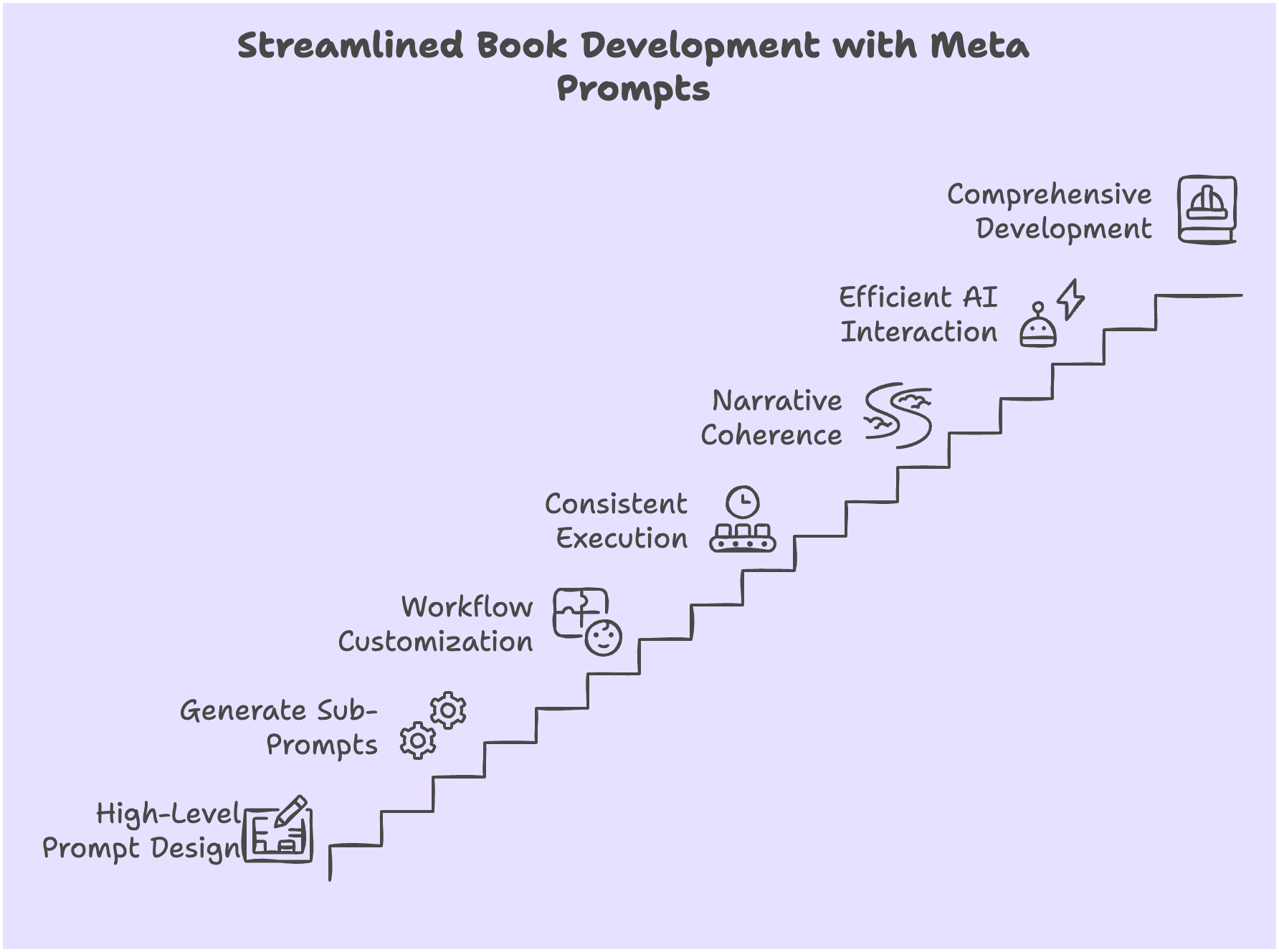 Instead of simply creating static prompt templates for workflows, you can now leverage meta prompts to generate customized prompts dynamically within your process. While this might seem like a subtle shift, it’s quite powerful—these tailored prompts consistently deliver more refined and precise results. I’ve found this approach particularly effective when building complex AI workflows that need to adapt to different scenarios or user inputs.
This systematic approach not only streamlines your workflow but also ensures consistency and thoroughness throughout your book project. Rather than crafting individual prompts on the fly, you’re working with a carefully orchestrated sequence that covers everything from outline development to chapter creation and content refinement.
I’ve found this method particularly powerful because it helps maintain a coherent narrative structure while maximizing the efficiency of your AI interactions. It’s like having a detailed roadmap that guides you through each stage of your book’s development, ensuring no crucial elements are overlooked.
Technical Teams Building Code AssistantsIt’s not just about marketing. You can create metaprompts that auto-generate developer prompts for debugging, documentation, and test-driven development. For instance:
Complex Reasoning & Problem-SolvingMetaprompting excels in tasks that involve multi-step logic or scenario exploration. Each sub-prompt can guide the AI through a piece of the problem, making sure no important detail gets overlooked. For example, it might break down an economic analysis into short-term vs. long-term impacts or factor in environmental vs. policy vs. market concerns.
Customer Support & ChatbotsCustomer interactions vary widely. A metaprompt can automate how new Q&A prompts get created whenever unknown inquiries arise—especially useful for refining chatbot behavior without writing separate instructions each time.
Educational Content & Personalized LearningWant to tailor content to different reading levels or learning styles? A metaprompt can generate customized prompts that adapt tone, complexity, and structure to fit a variety of educational needs.
Implementation Framework That Actually WorksOver time, I’ve refined a practical workflow that merges general best practices with real-world lessons. Here’s a concise blueprint:
My Favorite Metaprompt Workflow: Creating the Perfect Prompt (In Minutes Not Hours)When it comes to crafting effective AI prompts, I’ve developed a streamlined, four-step workflow that transforms rough ideas into professional-grade prompts in minutes. Here’s how it works:
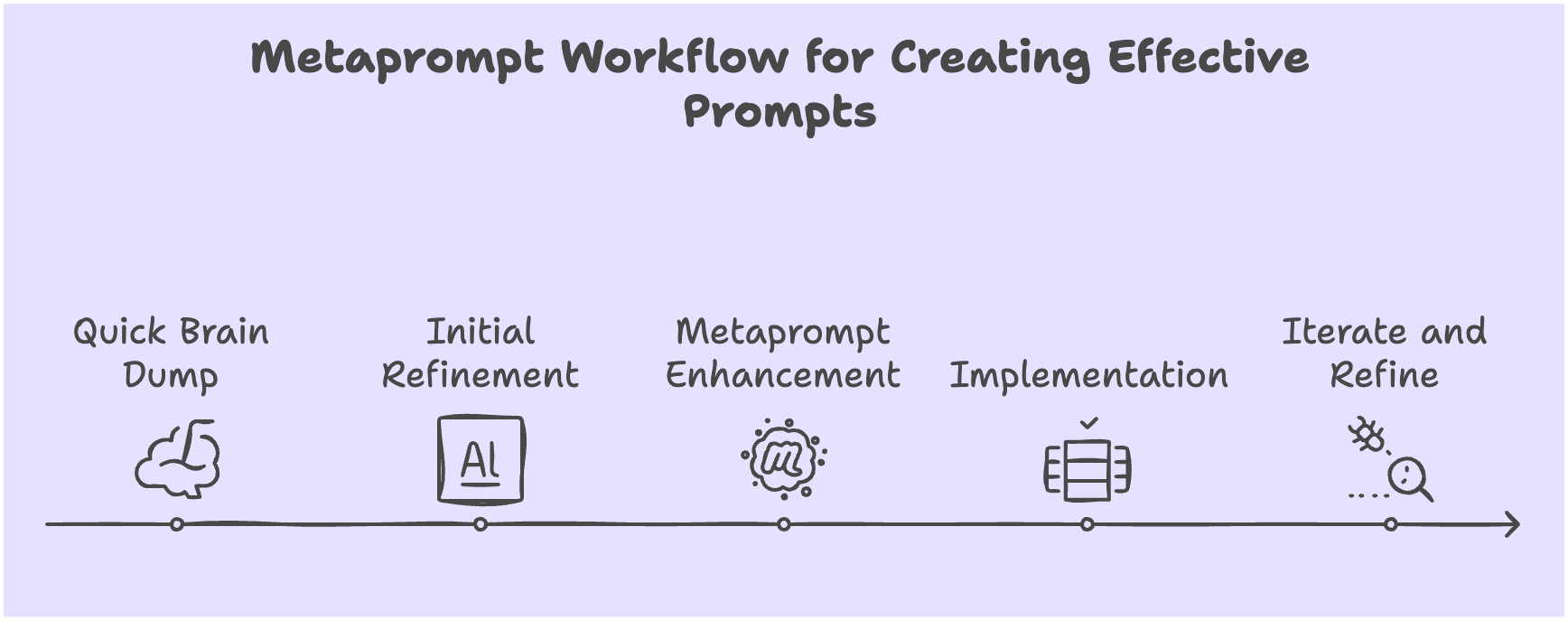 – Quick Brain DumpStart with voice dictation (Superwhisper, ChatGPT Mac App, or Whispering App) to capture raw ideas rapidly, without worrying about structure or formatting. This keeps the creative flow uninterrupted.
This approach combines the speed of spontaneous ideation with the precision of professional prompt engineering, all while maintaining efficiency. It’s particularly valuable when you need to generate high-quality prompts consistently, whether for daily use or specific projects.
I pretty much use this process for all my important prompts/ workflows. For simple tasks, I simply use voice dictation raw outputs (speaking allows you to get really detailed instructions very quickly).
Example: A Simple Metaprompt in ActionImagine you want a prompt that encourages an AI model to create a product roadmap. Here is a minimal example:
You are a prompt engineering expert. Please significantly enhance this prompt:

"Write a product roadmap for our new project management software that highlights our USP of real-time collaboration."

Please apply prompt engineering best practices to make this prompt produce extraordinary outputs. Also I would like you to Structure this prompt as if a prompt engineer spent hours refining.
Now here is your brand new prompt:
Role & Context Primer
"Act as a seasoned product strategist with 10+ years experience in SaaS development. You're creating an investor-grade roadmap document for stakeholders who need to understand both technical feasibility and market potential. The company operates in a saturated project management space dominated by Asana, Monday.com, and ClickUp."

Core Objective

"Develop a 12-18 month phased product roadmap that makes real-time collaboration the central narrative across all development stages. The output should make competitors' offerings feel outdated by comparison."

Structural Requirements

1. Foundation

   - Begin with an executive summary contrasting market gaps vs our real-time capabilities

   - Include 3 personas (e.g., remote technical team lead, creative agency PM, enterprise program director)

2. Roadmap Phases

   - Format as quarterly blocks (Q1 2024 - Q3 2025)

   - Each phase must contain:

     * Theme name (e.g., "Synchronicity Foundation")

     * 3-5 features demonstrating real-time evolution

     * Technical dependencies

     * UX differentiators

     * Metric targets (e.g., "Reduce co-editing latency to <120ms")

3. Competitive Moats

   - Dedicated section analyzing how each phase:

     a) Surpasses current market solutions

     b) Creates switching costs

     c) Enables network effects

4. Innovation Mandates

   - Include 2 'Blue Ocean' features per phase that don't exist in current PM tools

   - Example framework: "What would Figma/Miro do for task management?"

5. Risk Mitigation

   - Technical: Scalability challenges for 500+ concurrent users

   - Behavioral: Overcoming async work habits

   - Compliance: Data residency requirements for real-time global teams

Delivery Format

Markdown with collapsible sections

Visual timeline using text-based Gantt (ASCII art)

Glossary explaining technical terms to non-technical readers

Appendices for API documentation plans and third-party integration pipelines

Tone & Differentiation

Position as "The Figma of Project Execution" throughout

Emphasize visceral benefits over technical specs ("feel telepathic" vs "WebSocket integration")

Include 3 paradigm-shifting analogies comparing to revolutionary tools (e.g., "Like Google Docs meets Jira")

Constraints

No generic collaboration features (comments, @mentions)

Assume technical debt from legacy codebase

20% budget allocated for emerging tech experiments (CRDTs, WebAssembly, etc.)
📌Note: For best results, consider using a reasoning model like DeepSeek R1 or GPT’s o1 for the metaprompt (which o1, for some reason, tends to outperform o3-mini for this task). I used DeepSeek R1 here.You would then take the newly generated prompt and paste it into a fresh chat (or another AI model). You’ll notice the output suddenly becomes much more professional—potentially orders of magnitude better than what a simple prompt could achieve. For instance—notice all these extra details in the enhanced version? If you would have provided the AI with your simple prompt, it probably wouldn’t have produced anything close to the depth and completeness you can achieve with this enhanced prompt.
🚀 Pro Tip — Require Clarifying Follow Up Questions
When creating the metaprompts, you can enhance their effectiveness by including instructions for the AI to ask follow-up questions. This simple yet powerful technique helps uncover crucial details you might not have initially considered. By doing this, you’ll receive a final prompt that’s precisely tailored to your specific requirements—often leading to significantly better results than a one-shot prompt attempt (and potentially less iterations).
I’ve found this approach particularly valuable when working with complex prompting scenarios where requirements might not be immediately obvious. The AI’s targeted questions can help surface important context and constraints that could make the difference between a generic output and one that truly serves your needs.
Then, you can fine-tune the meta prompt OR your enhanced prompt by either adjusting it manually or telling the AI how to iterate based on what you don’t like in the final results. The results typically surpass those of a straightforward prompt. However, how much better your outputs become will vary depending on the task and the model you use.
For example, if you do a Metaprompt w/ Simple Prompt → Enhanced Prompt → New Prompt approach with something like an email message, you might only see slight improvements. But for business-focused tasks—like product roadmaps or SEO content direction—this process can yield significant benefits.
It’s as if a seasoned prompt engineer spent hours crafting these prompts, yet it only took you minutes, and you didn’t have to know a thing about prompt engineering.
My friends, this is the power of metaprompts—and, in my opinion, it’s where prompt engineering is headed for both beginners and advanced users alike. As these techniques continue to develop and reasoning models become more sophisticated—taking on more autonomous, agent-like thinking—I believe the distinction between “casual users” and “prompt engineers” will gradually diminish.
Advanced Techniques: Want to Get Even More ‘Meta’? Try A Meta-Meta PromptI’ll be honest—I’m a lazy prompt engineer. I leverage AI to do almost all the heavy lifting in my prompt engineering tasks. However, I maintain firm control over the strategic direction and final quality. My role centers on steering the AI, oversight, refinement, and iteration & feedback rather than writing every prompt from scratch.
One of my favorite efficiency techniques involves using AI to generate metaprompts. Think of it as a “meta-meta-prompt” or “recursive metaprompt” approach. While it might sound complex, this method has proven incredibly valuable for streamlining my AI workflows.
The key lies in the iteration process. That’s where I invest most of my energy, guiding the AI to implement specific refinements while I focus on the higher-level strategy and quality control. This approach combines efficiency with expertise—letting AI handle the heavy lifting while ensuring the final output meets professional standards.
A “meta-meta prompt” (sometimes called a “recursive meta prompt”) is basically a set of instructions that tells the AI to generate a meta prompt—which itself is a prompt that outlines how to create or refine other prompts.
In other words, it’s one layer deeper in the prompt hierarchy:
When you go to a meta-meta level, you’re effectively telling the AI to build the blueprint that outlines how to build another blueprint. It may sound extreme, but this approach can be powerful for large or complex projects, especially if you need to maintain consistent quality and style across multiple tasks.
Want to go deeper? Sure—sometimes I even have the AI create a metaprompt that itself builds a whole series of metaprompts (yes, it gets that meta). But let’s not go too far down the rabbit hole for now.
Common Pitfalls (And How to Dodge Them)Metaprompting opens up powerful possibilities but isn’t foolproof. Watch out for these common snags:
The Ethical EdgeMetaprompting can accelerate content creation, but it also amplifies potential risks. If your brand/company require, you can set safeguards, for example:
Additionally, keep fairness, inclusivity, and compliance in mind for any domain-specific guidelines—especially in regulated fields like finance or healthcare. Human review remains the ultimate safety net (and is also important for the metaprompt iteration process).
Tools Worth Your TimeYou can do plenty within a standard ChatGPT interface, but specialized tools make metaprompting smoother, more efficient and scalable:
Opportunity-Focused ObservationsMetaprompting opens doors across industries and creative fields. Some notable opportunities include:
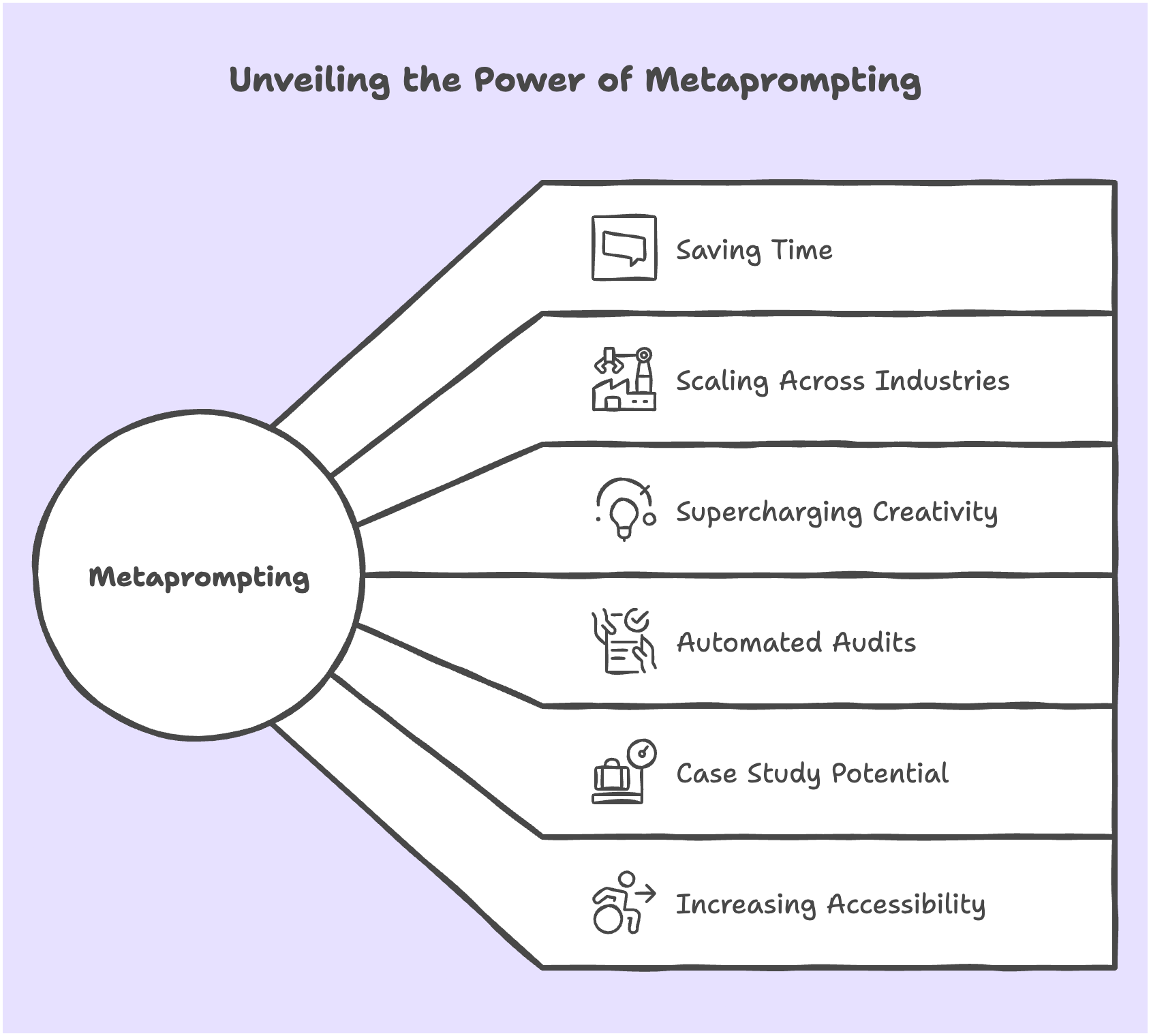 – Saving Time:Meta-prompting accelerates crafting effective prompts, enhancing precision and efficiency. It streamlines the process for both beginners and experts, consistently yielding high-quality instructions—like having an expert prompt engineer by your side.
The Road AheadWe’re moving into an era of recursive improvement, where AI models can refine their own prompt generation logic over time. Researchers are already exploring:
Expect ongoing leaps in tooling and best practices. Being open to iteration will keep you ahead in this rapidly evolving landscape.
Final TakeawaysMetaprompting represents a powerful evolution in prompt engineering. Rather than painstakingly crafting individual prompts, you specify how prompts should be created. This “meta” layer scales your AI efforts, boosts creativity, and ensures consistency—especially when you’re juggling numerous tasks or complex requirements.
Whether you’re generating sophisticated chatbots, launching marketing campaigns, or tackling specialized technical problems, metaprompting offers a sustainable framework that makes prompt creation more systematic and less error-prone. It’s not about eliminating human expertise; it’s about amplifying it. By embracing metaprompting now, you’ll not only cut down on guesswork but also position yourself to ride the next wave of AI innovation.
Frequently Asked QuestionsQ: What exactly is metaprompting?A: Metaprompting is a dynamic technique that goes beyond crafting simple prompts—it establishes a high-level blueprint for how an AI should generate, refine, and tailor its own prompts. By creating a “prompt for prompts,” metaprompting enables the AI to adapt its instructions to fit diverse, context-specific needs, resulting in more consistent, efficient, and scalable outcomes.
Q: Who benefits most from using metaprompting?A: Whether you’re a solo innovator or part of an enterprise team, metaprompting can streamline your workflow by reducing repetitive work and ensuring consistent quality across outputs.
Q: How does metaprompting improve prompt engineering?A: Metaprompting improves prompt engineering in two key ways. If you have a solid master blueprint, it standardizes tone, structure, and quality—automating much of the creative process. Alternatively, even without a fixed blueprint, metaprompting empowers the AI to generate and refine prompts on its own, saving time and streamlining experimentation for more effective outcomes.
Q: Can metaprompting adapt to different industries?A: Absolutely. From marketing campaigns to technical documentation and educational content, metaprompting offers a flexible framework that can be tailored to any domain.